
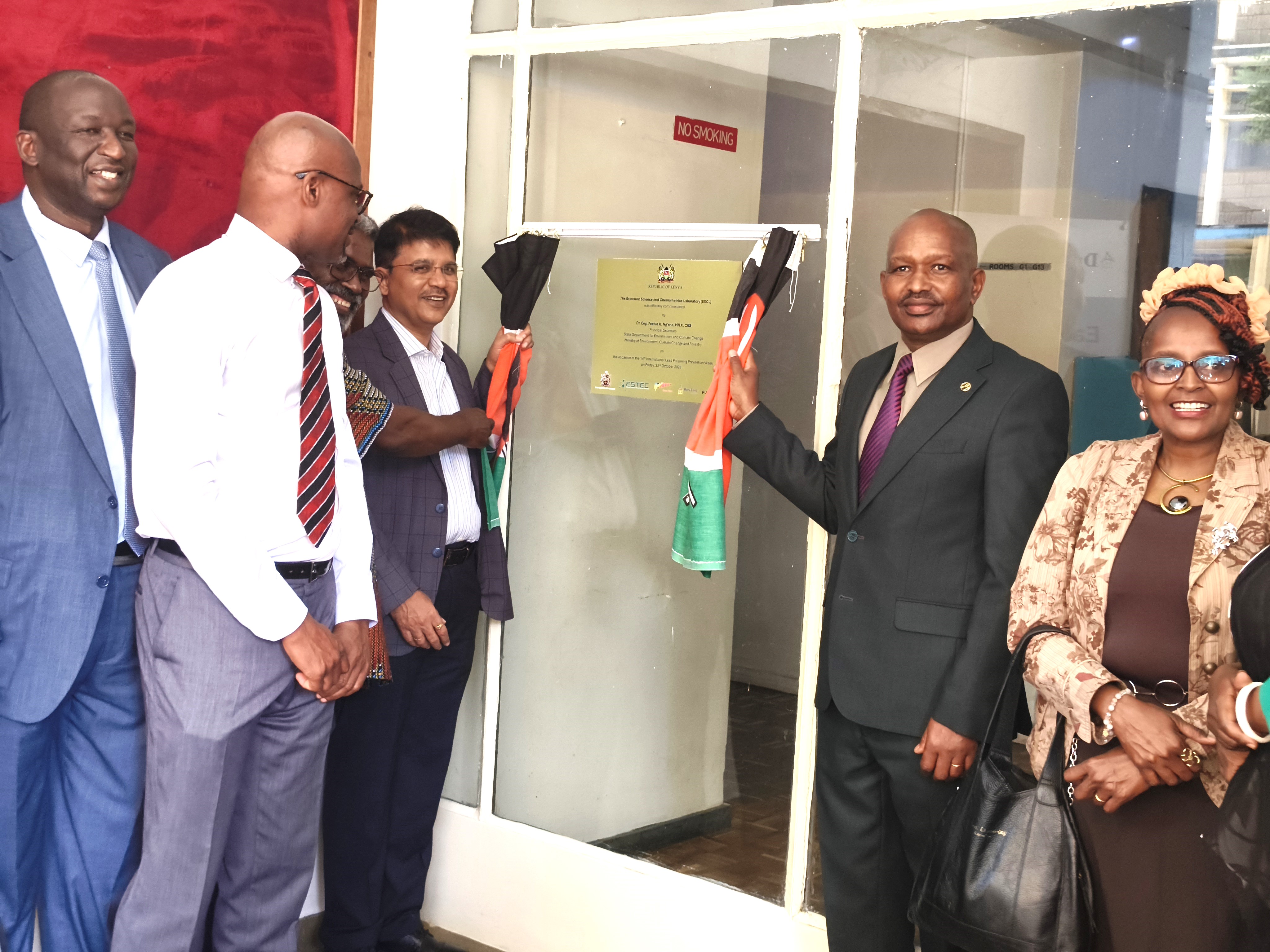
NAIROBI, Friday, 23rd October 2026 – The University of Nairobi successfully hosted the 14th International Lead Poisoning Prevention Week of Action (ILPPWA) at its Chiromo Campus. Held under the theme “From Detection to Prevention”, the week-long event concluded with a high-level ceremony featuring the official commissioning of the University’s Exposure Science and Chemometrics Laboratory (ESCL) and the handover of critical national policy briefs “Moving from Detection to Prevention of lead-based pigments in Paints to mitigate lead Exposure in Kenya”
Presiding over the function as Chief Guest, the Spouse of the Deputy President of the Republic of Kenya, H.E. Dr. Joyce G.N. Kithure, called for an urgent paradigm shift from merely detecting lead contamination to actively preventing exposure particularly among children, who are vulnerable. Dr. Kithure urged government agencies, researchers, and industry leaders to translate scientific evidence into practical, enforceable interventions, emphasizing that public safety is a shared responsibility requiring robust public education and regulatory enforcement.
The newly upgraded ESCL was officially commissioned by the Principal Secretary for Environment and Climate Change, Dr. Eng. Festus K. Ng’eno. In his address he noted that national priorities must move upstream to keep hazardous raw materials such as lead chromates out of domestic supply chains. He highlighted a milestone University study led by Dr. Faridah Were, which revealed that 88 percent of sampled yellow road-marking paints exceeded Kenya’s legal limit of 90 parts per million (ppm) up to 186,000 ppm. To counter this, the government is moving to establish dedicated customs codes for lead chromates and co-sponsor African proposals under the Rotterdam Convention.
Representing the Vice-Chancellor, Prof. Eng. Ayub N. Gitau, the Deputy Vice-Chancellor (Human Resources and Administration), Prof. Leonida, underscored that detection is merely the starting point. She noted that the new laboratory will empower the University to conduct independent analyses, generate credible local data, and train future analysts through Competency-Based Education and Training (CBET).
The event drew distinguished leaders from the National Environment Management Authority (NEMA), the Kenya Bureau of Standards (KEBS), the National Research Fund, UNEP, the Directorate of Multilateral Environmental Agreements, and Nairobi County’s health services.
Speaking on behalf of the Faculty of Science and Technology, Acting Dean Prof. George Ongamo reiterated the faculty's commitment to ensuring that scientific inquiry directly serves society and informs enforceable policy. Department of Chemistry was represented by Acting Chairman Prof. Damaris Mbui, who added that academic data becomes truly impactful when it provides the empirical foundation for upstream policy interventions.
The overall coordinator of the Week and ESCL Research Group Leader, Dr. Faridah Were, detailed the collaborative upgrades that transformed the laboratory. Enhanced through contributions from ESTEC and BASCO Paint Products, the facility will be equipped with advanced instruments provided by Pure Earth, that include Type I ultrapure water purification system, a laboratory hybrid fume hood and with roof top ducting system, and a clinical specimen freezer; Vital Strategies, which provided a microwave digester; and the University of Washington’s Lead Exposure Intervention Project, which supplied X-ray fluorescence (XRF) analyser. Dr. Were handed over the Executive Summary and Policy Recommendations to the Principal Secretary’s representative, noting that additional studies have uncovered elevated lead and chromium levels not only in road marking paints, but also in yellow, green, and red oil-based residential paints implicating lead chromate pigments.
Delivering remarks on behalf of Pure Earth, East Africa Director Mr. Firew Kefyalew Mekonnen highlighted the staggering global scale of the crisis, noting that up to 800 million children worldwide suffer from harmful blood lead levels. He emphasized that Pure Earth is dedicated to solving pollution problems in low- and middle-income countries by finding where people—especially children—are being exposed and working with governments, industry, and communities to stop it. He noted that when measuring lead at parts per billion, ordinary laboratory water carries enough metal to distort results, making ultrapure water essential, while the fume hood protects technicians from hazardous acid vapors, and the freezer keeps biological specimens intact on their journey from the community to the bench. He underscored that the true measure of the new laboratory will ultimately be measured by “the exposures prevented and the children protected.”
Mr. Griffins Ochieng, Director of the Centre for Environmental Justice and Development (CEJAD), pointed out that raw lead chromate pigments currently lack specific Harmonised System (HS) codes, complicating border tracking. CEJAD is actively preparing a proposal to list these pigments for prior informed consent under the Rotterdam Convention.
Furthermore, Mr. Tom Ouma of ESTEC Limited noted that the facility is poised to become a premier regional research hub upon achieving full ISO 17025:2017 accreditation. BASCO Paint Products was widely recognized for its decade-long industry leadership in pioneering lead-free paint transitions in Kenya from Detection to Prevention.
Lead poisoning is preventable, and prevention must start at the source.The Week matters because lead silently damages children’s developing brains, and exposure often comes from everyday products such as paint. The way forward lies in tighter import controls, enforcement of the legal limit, international listing of lead chromate, safer alternatives from industry and public awareness. The University of Nairobi will contribute through its new laboratory, providing independent testing and credible local data, training future analysts and grounding national policy in evidence. Working together, Kenya can stop lead poisoning before it starts.
- Log in to post comments